Wool and mutton trains!
Farm and slaughterhouse railways?
The existence of farming railways especially in such a 'wild and distant part of the world' may be doubted. However, whilst this may be the Uttermost Part of the Earth it was certainly developing well by the early 1900s. E. Lucas Bridges in his book of that name (1) records that from 1908 the Estancia Viamonte in Argentine Tierra del Fuego used a five ton portable engine to power the sawmill and later the sheep-shearing shed, and that some of the bigger estancias had up to 200,000 sheep. It is quite possible in the circumstances that more estancias and frigorificos (abattoirs & freezer plants) had railways. Any further information would be appreciated.
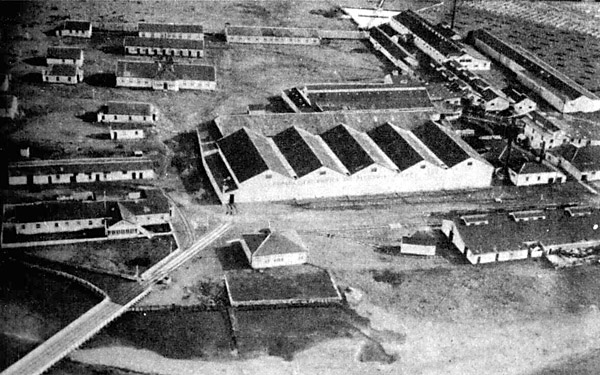
The aerial photo below shows part of the Puerto Sara frigoríico near Estancia San Gregorio. The size and extent of the buildings (which extend beyond this clipped picture) show that it is a frigorifico rather than merely an estancia. The photo was provided by Señor Raúl Moroni from a Chilean railways summer holiday guide (!). Although not obvious in this low-resolution version there are railway tracks, at least one covered van, and a double-track muelle off to the bottom left.
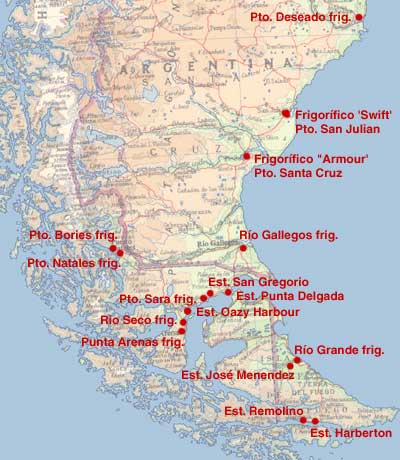
Map of known estancia and frigorifico railways
The map below shows the location of all the known or rumoured lines.
Individual pages for each location
Each of the railways whose existence has been confirmed has its own page, accessible by clicking on the grey titles in the page header above.
Other reported sites
It is quite possible that there were other railway lines not yet recorded. Possibilities are mentioned below, though no information could be found in the Ushuaia museums.
Estancia Remolino
There was a railway line at this estancia which lies between Ushuaia and Puerto Harberton. The line was used to carry timber from the Cañadon Remolino to the estancia's sawmill, and possibly wool to the shore. The line's existence is confirmed in Rae Natalie Prosser Goodall's book on Tierra del Fuego (2), but Carlos Vairo of the Ushuaia Maritime Museum reports that it did not use anything other than man and horse power.
Estancia Harberton
This location is also east of Ushuaia on the Beagle Channel. One source suggests that a book written by a previous resident here shows a Krauss locomotive on a train within the estancia. I have not been able to trace the book or any confirmation that the line existed. Mrs. Goodall, whose guidebook is mentioned above, lives at Harberton but makes no mention of any railway line.
Paso Marsicano
The ria on which Puerto Deseado sits extends some 45 km westwards to end near Paso Marscicano. There was an estancia there connected by a narrow gauge track to its own muelle.
Raúl Moroni of Santiago de Chile reports having seen narrow-gauge industrial tracks next to a road in San Julián when there in 1997. Note, this will not have been at the frigorífico which was several kilometres north of the town.
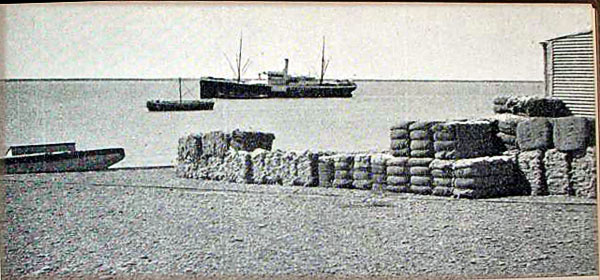
The following photo taken at Puerto Santa Cruz, probably in the early 1940s, appears to have a rail track just in front of the wool bales though this is not absolutely clear (5).
Señor Mateo Martinic (4) suggests that other large estancias having therir own coastal muelles included those at Gente Grande, Bahía Felipe and Caleta Josefina. Any of these might have had short hand-worked railways.
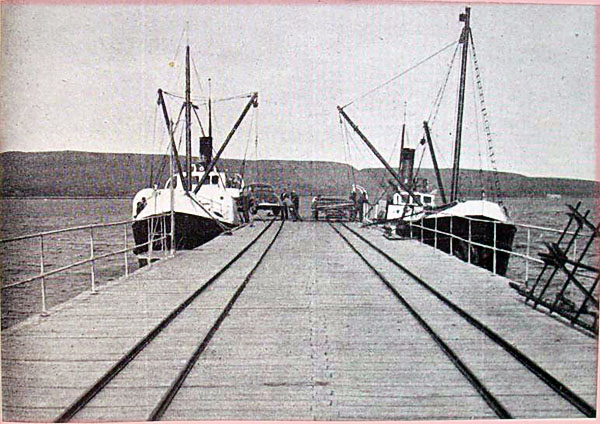
The public muelle at Porvenir in Chilean Tierra del Fuego, showing a double line of 60cm gauge tracks and a pair of Jubilee/Decauville type points leaning against the railings at the right (6). The car looks more like one from the 1950s, but given that the original publication of the photo was in 1942, it might have been an American vehicle from around 1940.
The muelle at Estancia Paine on Lago ???. A rail track is clearly visible.
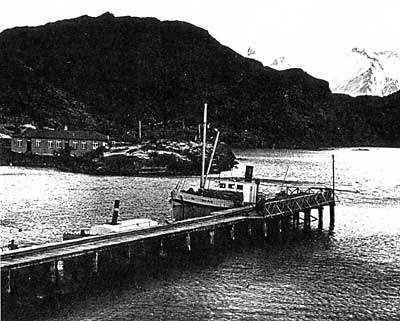
Unidentified lines on jetties
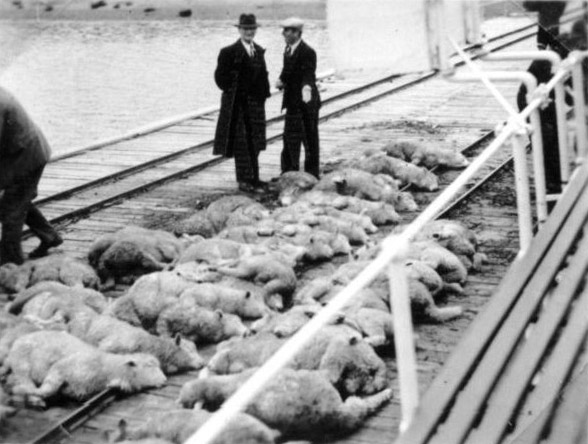
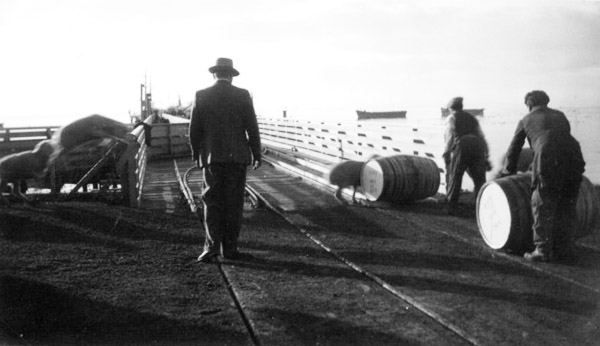
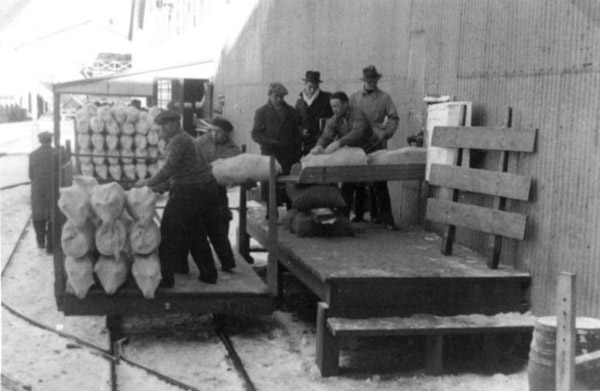
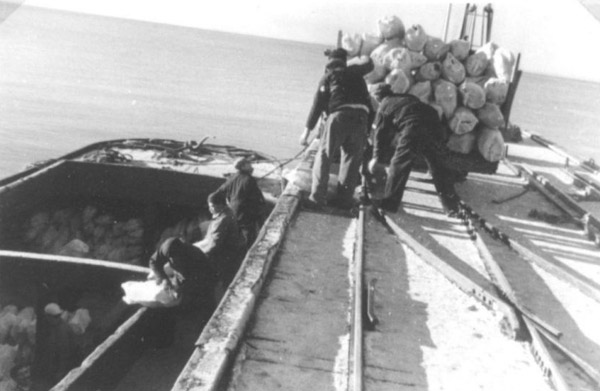
A number of photos have surfaced showing railway tracks in unspecified locations. Several of these are displayed below in the hope that someone might recognise the source and thus the name of the muelle or estancia.
This one shows 60cm gauge track and slaughtered sheep alongside a vessel, thus making it likely that it is at an estancia rather than a frigorífico.
A double track muelle, with the gauge being probably one metre.
Frozen carcases being loaded onto a small metre (?) gauge wagon at a frigorífico. Another wagon already loaded is in the background.
Almost certainly at the same location as the previous picture carcases are being loaded into a lighter to be taken out to a ship. The double-tracked muelle has a crossover at th end to allow empty wagons to be released and returned to the shore.
Farm railways in the Falklands
A number of farms in the Falklands Islands similarly had short hand-worked rail tracks between shearing shed and jetty whilst there too could be found meat processing plants needing transport for materials and products. These are covered in Chapter 11.
Other steam
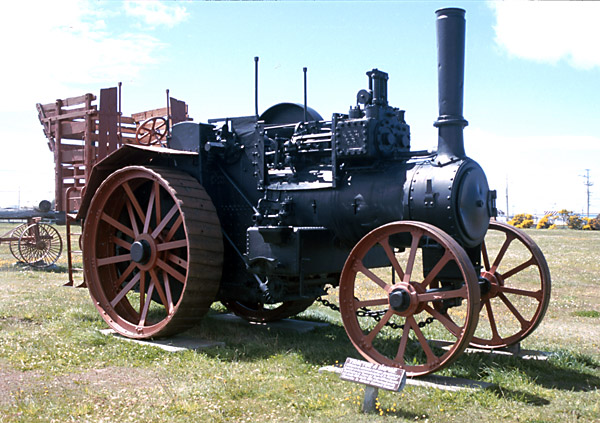
Even when railways were not practicable steam power was used. As well as the portable engines mentioned above, large 'colonial' style traction engines did a lot of the heavy hauling between ports and estancias. The photo below shows a colonial type McLaren engine now preserved at the Instituto de la Patagonia in Punta Arenas. The large tender framework carried the wood fuel. Other derelict machines can occasionally be spotted at roadsides.
This is a McLaren 8hp road loco, nominally of 12 tons weight, though probably rather heavier as McLaren's tended to build to last! It was built in 1913/4 as works no. 1570, and shipped out to Patagonia to an unknown customer. Similar engines nos. 1295 and 1296 had been delivered to this area in 1912. No. 1295 ended up at Estancia Stag River near Río Turbio on the Argentine side of the border and has recently been repatriated to England where it is being restored by Richard Morris of Worcester. No. 1296 at some time or other donated its slide valve cover to the machine pictured below, which explains the mistaken identity reported on various previous occasions. It is not yet clear whether the initial delivery was made to Chile or Argentina, but certainly the water and wood necessary to operate such an engine would have been in more plentiful supply west of the border!
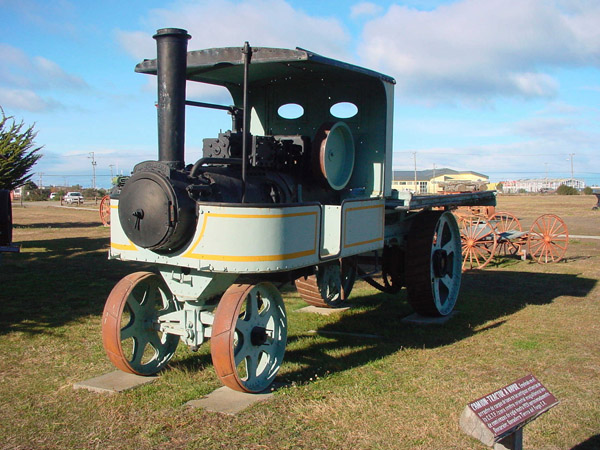
The next photo shows a Mann steam wagon as used by the SETF for carrying wool bales. This too is now preserved at the Instituto de la Patagonia. The photo is by Richard Morris, 2003.
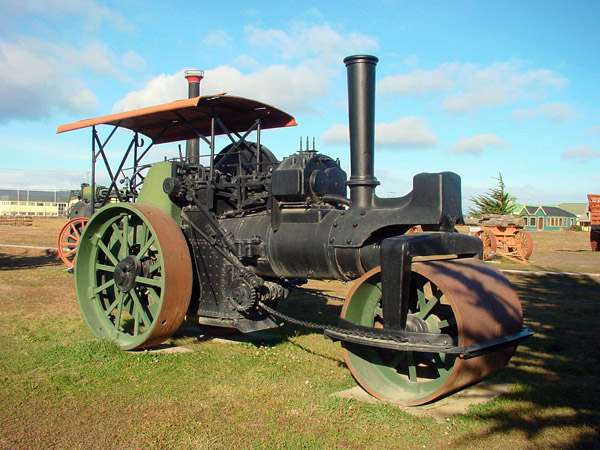
Finally, nothing to do with estancias or frigoríficos, an Aveling & Porter road roller once owned by the Punta Arenas municipality. This too is now preserved outdoors at the Institute. This is another of Richard Morris's photos.
References:
1 The Uttermost Part of the Earth, 1948. E. Lucas Bridges, Hodder & Stoughton, London.
2 Tierra del Fuego. 1970, 1975, 1978. Rae Natalie Prosser Goodall, Ediciones Shanamaiim, Güemes 4215 Buenos Aires, or Casilla 41 Ushuaia.
3 Reseña 1965, Junta Nacional de Carnes,pp. 53, 54 and 95. Information forwarded by Señor Sylvester Damus.
4 Ferrocarriles en el Zona austral de Chile 1869-1973. Mateo Martinic, 2005. Instituto de Historia, Pontifica Universidad de Chile, Santiago. Available on the web.
5 Photo discovered in Tierras Australes, Jerónimo Gómez Izquierdo, published by Empresa Editorial Bell, Buenos Aires,1942, page 123, and kindly forwarded by Señor Diego de Bunder of Puerto Madryn.
6 Ibid. page 187.
11-2-2018
|